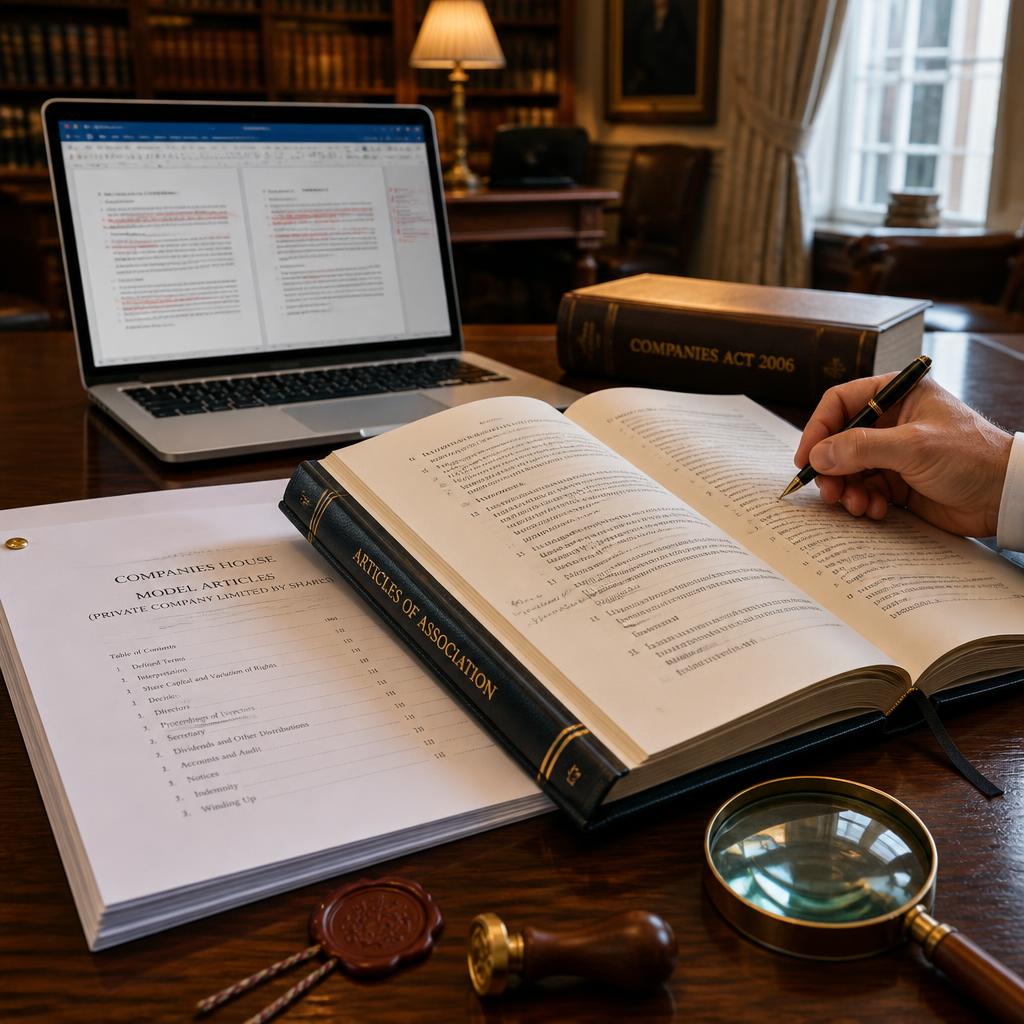
Articles of association are the constitution of a UK Limited Company. They set out how directors are appointed and removed, how shares are issued and transferred, how dividends are declared, and what shareholders can force the company to do — and not do. Every UK company has articles. The only question is whether you accept the government's default, or write your own.
For most companies, the Model Articles are a competent starting point and a poor finishing point. They are drafted for a hypothetical simple company with a single shareholder, a single share class, and no ambition beyond a family trading business. If that is your company, use them. If it is not — if you plan to raise investment, hire on equity, bring in a co-founder, or exit — the Model Articles will start costing you money before the second year is out.
What articles actually do
Under section 33 of the Companies Act 2006 the articles bind the company and each member as if signed and sealed by them. Every share issue, transfer, director appointment and distribution is governed by them. When there is a dispute, the court reads the articles first, the shareholders' agreement second, and correspondence third.
The Companies (Model Articles) Regulations 2008 prescribe three defaults — for private companies limited by shares, private companies limited by guarantee, and public companies. If no articles are registered on incorporation, the Model Articles apply automatically to whichever type of company is formed. Companies incorporated before 1 October 2009 usually still operate under the older Table A of the Companies Act 1985 until updated.
What Model Articles cover well
Article 3–7: directors manage the company; decisions by majority; chair has casting vote.
Articles 21–29: allotment powers, share certificates, transfer procedure.
Articles 37–41: notice, quorum, proxies, voting on show of hands and poll.
Articles 30–36: dividends must be recommended by directors, paid pro-rata, no preferential rights.
The Model Articles are a genuinely competent skeleton for uncomplicated single-class companies. Directors can meet, pass resolutions, allot shares, declare dividends and file confirmation statements without any bespoke drafting. What they cannot do is handle the second layer of corporate life — multiple classes, leaver events, investor rights, transfer controls.
Six places Model Articles reliably break down
Model Article 22 assumes shares of a single class. The moment you want ordinary A/B/C, growth shares, non-voting shares or preferences, the Model Articles need supplementing or replacing. Attempting to run classes under unamended Model Articles causes deep ambiguity on voting and dividend rights.
Model Article 26 gives directors a discretion to refuse a transfer but no framework — no pre-emption, no compulsory transfer on death or departure, no drag/tag. In practice this means a departing shareholder can sell to anyone, and a minority can block a sale to a strategic buyer.
Model Articles do not distinguish a founder leaving amicably from one dismissed for cause. Without leaver provisions, a co-founder who exits after 18 months keeps their full equity — a structural risk to the remaining team.
Model Article 13 gives the chair a casting vote. In a two-director, 50/50 company this is fine only if the chair is genuinely neutral. For most joint-founder companies, this needs to be replaced with a mediation/buyout mechanism.
Model Articles contain no reserved matters, no investor consent rights, no anti-dilution — everything an institutional investor expects. The shareholders' agreement can cover some of this, but articles-level protection is stronger and binds successors.
Statutory pre-emption under section 561 CA 2006 applies unless the articles disapply it. Model Articles do not disapply pre-emption at all — every option grant technically triggers a pre-emption offer. Bespoke articles routinely disapply pre-emption up to a defined option-pool cap.
The eight clauses a bespoke set must handle
A proper definitions clause covering Investor, Founder, Bad Leaver, Good Leaver, Exit, ERV, Ordinary Course of Business, Permitted Transferee. Model Articles have no defined terms at all — every drafting improvement below relies on defined terms.
Full drafting of ordinary shares, any alphabet classes, growth shares (with defined hurdles), and — if relevant — preference shares (with liquidation preference, dividend coupon, conversion, anti-dilution).
Statutory pre-emption preserved for genuine new capital, but disapplied up to a defined option pool nominal amount, and disapplied entirely on a bona-fide investment round approved by the board.
Existing shareholders offered a first right to buy any shares before they are sold to a third party. Time-limited offer, price mechanism (agreed price or independent valuation), and permitted transferees (spouse, family trust) exempted.
A founder or employee who leaves must offer their shares back to the company or continuing shareholders. Price depends on leaver classification: bad leaver at par or lower of par/market; good leaver at fair market value. Vesting overlay is common.
Drag-along: a majority (typically 50%+ or 75%+) accepting a bona-fide third-party offer can force minorities to sell on the same terms. Tag-along: any founder or majority sale must offer the same terms to minorities.
A list of matters (major expenditure, borrowing, share issues, disposals, changes to articles) that require investor consent. Information rights covering monthly management accounts, annual budget, audited accounts, and reasonable access.
For close companies: a defined deadlock mechanism (mediation, Russian roulette buy-sell, or independent chair). For investor-backed companies: expedited board resolution procedure and escalation to investor director.
Investor-ready articles: the seven-line test
An investor's lawyer opens the diligence on day one by reading the articles. Every clause below missing from the current set becomes a redraft on the timetable, and each redraft is redlined and negotiated at billable rates. Founders who arrive at a term sheet with articles that already handle these items save four to eight weeks and tens of thousands of pounds. Founders who don't, discover late that the "quick fix" articles they signed at incorporation cost more to unpick than a bespoke set would have cost to draft.
- Bespoke articles adopted at incorporation or before the first term sheet
- Ordinary shares only (no preference shares yet) to preserve SEIS/EIS eligibility
- Founder vesting and leaver provisions in the articles, not just the shareholders' agreement
- Option pool disapplication of pre-emption up to a defined nominal amount
- Drag/tag rights defined with clear thresholds
- Reserved matters list drafted to accept an investor director without material redrafting
- Class rights variation procedure matching section 630 CA 2006
When to switch and how
Best case: incorporate directly with bespoke articles. Companies House accepts custom articles at incorporation at no extra fee — the drafting cost is the same either way, and adopting bespoke articles at day one avoids every problem below. Realistically, most founders incorporate on Model Articles because that was the fastest route and only later discover the gaps.
To adopt new articles later: draft the replacement, pass a special resolution (75% majority), and file both the resolution and the new articles at Companies House within 15 days. If you have alphabet classes or preferences, the class rights variation procedure adds a further class consent — 75% of the affected class, or as the articles specify. Existing shareholders may resist changes that dilute their rights — this is negotiation, not paperwork.
Rule of thumb: adopt bespoke articles before you have to. The moment there is a term sheet on the table, or a co-founder threatening to leave, articles negotiation stops being drafting and starts being deal terms — with all the cost and delay that implies.
Bespoke articles drafted by senior advisors
Fixed-fee bespoke articles of association, drafted for founder companies and investor rounds.
View services →A 30-minute call to decide whether Model Articles or a bespoke set fits your situation.
Book an advisor call →Articles of association — advisor answers
How much do bespoke articles cost?+
For a founder-only or founder-plus-early-employees company, a good bespoke articles set costs £750–£1,500 drafted by a specialist. For an investor-ready set covering leaver provisions, drag/tag and preference share terms, expect £2,500–£5,000. Adopting later, under investor pressure, routinely costs three times this because it becomes negotiated rather than drafted.
Can I copy another company's articles from Companies House?+
Technically yes — filed articles are public — but strongly not recommended. Articles are usually drafted for the specific commercial position of that company, defined terms link across sections, and unpicking what applies to your situation typically costs more than a fresh draft. Reference use only.
Do I need a shareholders' agreement as well?+
Yes for most companies with more than one shareholder. Articles are public and bind all shareholders as members; a shareholders' agreement is private and can bind parties personally. The two work together: transfer restrictions, drag/tag and share class rights sit in the articles; commitments, warranties and confidentiality sit in the agreement.
Do Model Articles work for a solo founder?+
For a solo founder with no plan to raise investment or issue employee equity, Model Articles are usually adequate. The moment a second shareholder joins, employee options are contemplated, or investment is on the horizon, bespoke articles are the correct move.
How do I change existing articles?+
By special resolution of shareholders (75% majority). File the amended or replaced articles at Companies House within 15 days of the resolution. If the change affects class rights, the class rights variation procedure applies — usually 75% consent from the affected class in addition to the general resolution.
Do banks or investors read the articles?+
Yes — always. Bank onboarding teams read the articles for beneficial ownership provisions, transfer restrictions and unusual share classes. Investor lawyers spend the first week of every diligence on the articles and shareholders' agreement. Clean, well-drafted articles measurably reduce diligence cost and duration.
This article is general guidance based on the Companies Act 2006 and Companies House practice current at July 2026. It is not a substitute for tailored legal advice. UK Company Experts is a trading name of Seven Oak Prestige Ltd.
Related guides from our editorial library.
Browse all insights